

I thought of walking out of Kuttay: The Ones Who Don’t Bite at several points, a few people actually did. Not because the play was bad, but because it was so uncomfortable to watch. For those who stayed, it was worth it. Good art needs to shake us a little.
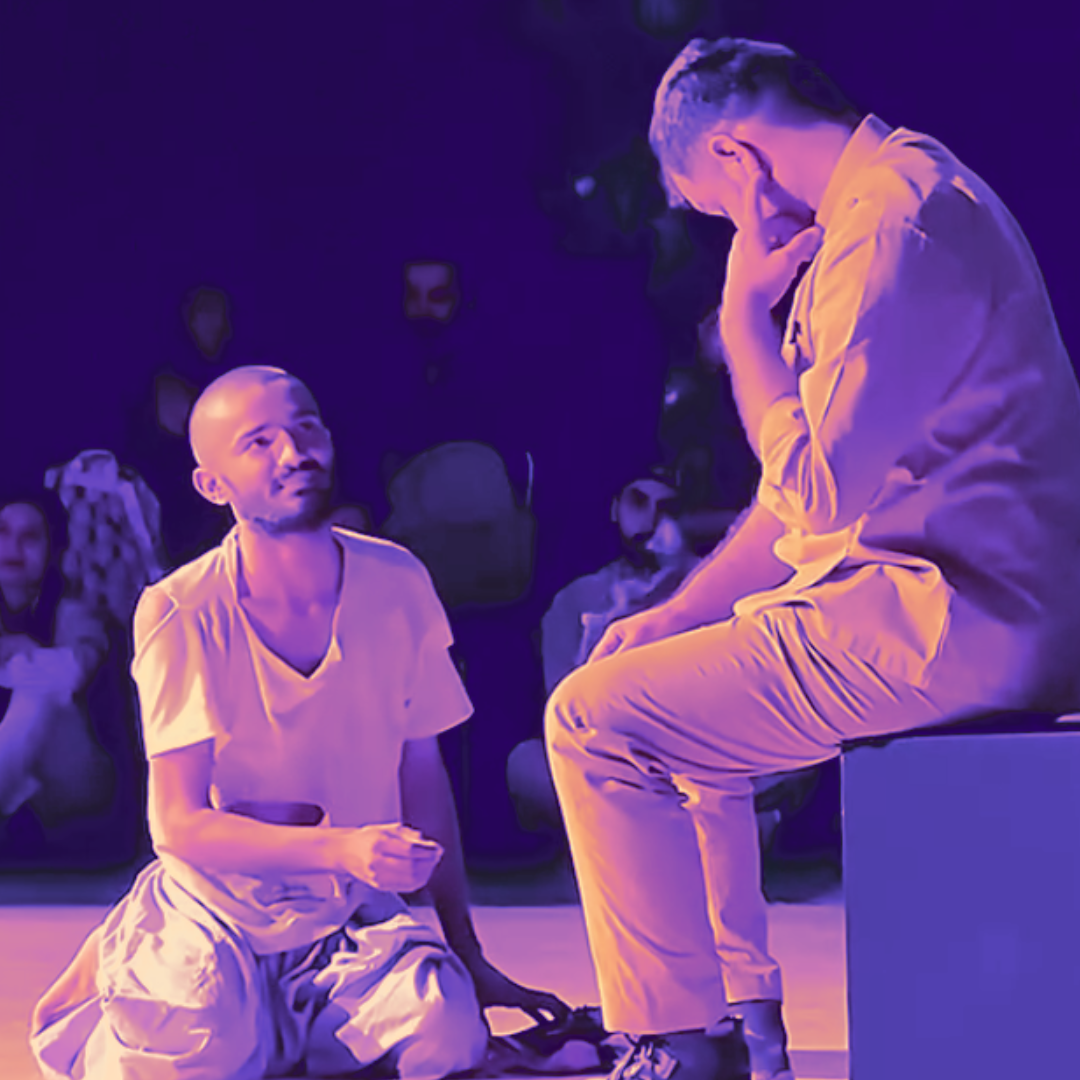
Director Muhammad Ali uses absurdism and chaos to create a compelling and haunting performance. Here the absurdity isn’t funny though, it’s horrifying. We see a man beaten, starved, and humiliated until he no longer remembers who he is, only that survival means surrender.
This is no traditional play with a fixed stage but a piece of performance art that tears down the distance between performer and spectator. We discover an actor is embedded among us. The cast of soldiers stomps in manic, unpredictable bursts and just like the desperate man at the centre of the story, we are disoriented, never certain of what comes next. The performance confuses us and makes us feel complicit in the machinery of control being depicted.
Their War Never Ends
Set after a war, we see a band of brutish soldiers lay siege to a poverty stricken man’s hut. The starving man (Arisar Rasheed) hopes that the military might help him and his traumatised wife. The scene could be set in 1947, or 1971, or now. The soldiers could be British, Indian, or Pakistani. The oppressive nature of violence is the same.
The soldiers prance in lascivious delight, mocking the poor man’s hunger and boasting about their lunch “a slice of the national highway” or a small “bite of income tax.”
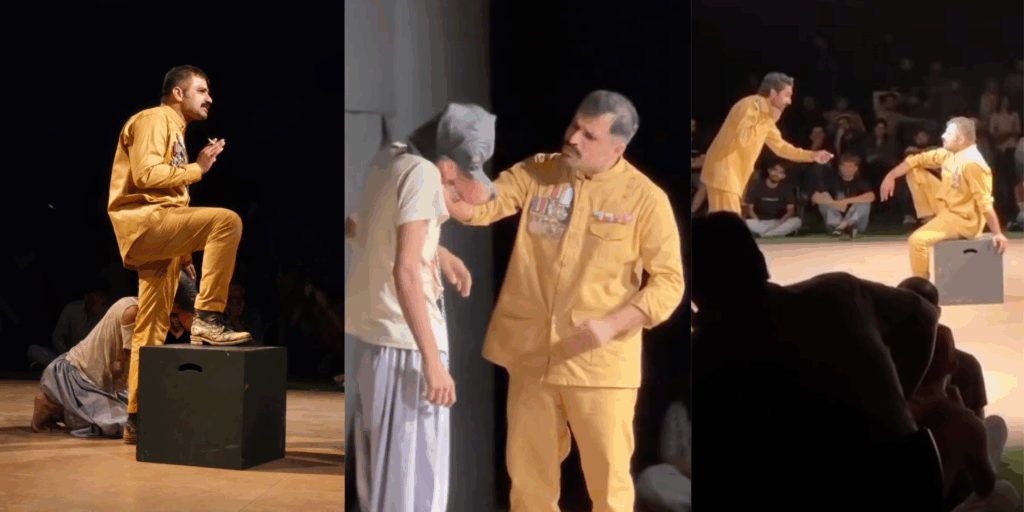
The Commander played by Zubair Baloch and his four soldiers morph constantly – one moment they are bureaucrats behind desks, the next they are medical officers, or faceless institutions. Their identities blur until it becomes impossible to tell where the uniform ends and the system begins. And through it all, the man at the centre of their cruelty asks for nothing but a scrap of roti.
Just when you think it’s over, the actor breaks the fourth wall and addresses the audience directly. You can’t just clap and walk away, you have been implicated. Kuttay doesn’t want to portray authoritarianism; it wants to show you how easily you live inside it.
What lingers after the play isn’t the violence or shouting but the recognition of what trauma does to people. The real horror is what happens when you have accepted humiliation as normal and survival instincts have been twisted into blind obedience.
Faiz’s Stray Dogs Come to Life
The performance is reminiscent of Faiz Ahmed Faiz’s poem also called Kutte, which captures the degradation of the proletariat, those crushed under the weight of empire, class, and hunger.
“Yeh galiyon ke aawaaraa bekaar kutte
Ke bakshaa gayaa jinko zauq-e-gadaai,
Zamaane ki phatkaar sarmaayaa unkaa,
Jahaan bhar ki dhatkaar unki kamaai.”
Faiz’s “stray dogs” are not animals but the working class reduced to desperation, beaten and humiliated until obedience replaces identity. The man in Kuttay mirrors this as he pleads for roti, stripped of humanity by promises that never feed him. Both the poem and the play expose how authoritarian systems thrive on the silence of the proletariat, and how the first casualty of class-war is respect.
A Play Without Borders
The play was originally conceived in India by an improv group, which explains its raw, unrestrained energy and freedom from convention. It was performed in 2014 to mixed reviews – perhaps the allegory is even more urgent today. The slogans change, the faces of power rotate, but the machinery of control stays the same.
I attended this play days after watching the Paul Thomas Anderson movie One Battle After Another, another piece whose source material was decades old. and yet the movie felt incredibly timely and relevant. While Kuttay showed the dangers of compliance, OBAA portrayed the heartbreaking failure of resistance. Both works ultimately ask how to stay human in an inhumane world.
We cannot afford to ignore the cruelty around us and live in apathy. Somewhere between foolish idealism positivity and resigned cynicism, there is actionable hope. In a world that attempts to dehumanise us, the greatest defence is perhaps radical humanity.