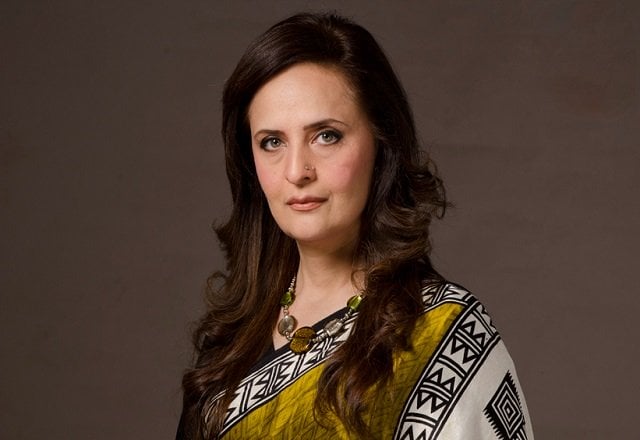



For those who follow Pakistani television, Misbah Nousheen is a familiar name. She is the writer of critically lauded dramas Ramz-e-Ishq, Sukoon and more recently Humraaz – a suspense thriller that spiralled into controversy.
It was meant to be her boldest work yet with a tightly-plotted psychological twist but devolved into a plodding, disjointed drama that left critics, audiences, and even the writer herself bewildered. The backlash was swift. But what was happening behind the scenes wasn’t visible – until now.
“No, actually, the script you’re watching now…it isn’t mine,” she says plainly speaking to Sheeba Khan for DramaPakistani.“It was changed. And not small tweaks…major structural changes. The main plot, the theme, even the rhythm. What I wrote was a fast-paced thriller. What aired was slow, confusing. I regret it deeply.”
It’s not just about bad edits or poorly delivered scenes. What Misbah describes is tacit creative theft – contractual and widespread. Once a writer submits their script to a production house, she explains, it becomes their legal property. The writer is cut off. The work is picked apart, rearranged, and shot, often in a way that bears no resemblance to the original.
“You find out only when it airs,” Misbah says.
“No one calls. No one asks. I begged them, ‘Please, if you want to make changes, just tell me. I’m available 24/7.’ But nothing. It’s like handing over your child and watching strangers raise it with no care, no thought.”
And yet, when Humraaz started to unravel, when reviewers and fans began questioning its logic the criticism landed squarely on her shoulders. That, she says, is the curse of being a writer in this industry.
“You’re the easiest to target. You’re not on the poster.
You’re not in the BTS videos. You’re just… invisible.”
Misbah expands on how it felt being lambasted for mistakes she dis not make. “Let me tell you something, success has a hundred fathers, but failure is an orphan. But I didn’t let Humraaz be an orphan. I owned it. And I think not everyone has that kind of courage.”
The story of Humraaz is not just about a script gone wrong
Misbah recounts the absurdity of watching key scenes on-air -scenes she never wrote, ones she says made no narrative sense. A character shot multiple times lies on the ground, refusing to die. “I texted Farooq bhai (the director) and said, ‘Why isn’t he dying?’ I was shocked…his eyes aren’t even closing!” she laughs, the disbelief still fresh. “Farooq said there were editing issues. But he had already left the project by then.”
The series, she says, became a kind of orphaned project.
Despite everything, she doesn’t lash out at the producers. In fact, she’s remarkably gracious about them. “When the backlash became too much, they actually supported me. They said, “We know your script was really good, and it got ruined.”
“Don’t take it to heart—it happens,” they said.
And they meant it. I’ve worked with them since 2019. Most of my best work has been with Geo and 7th Sky. There’s a loyalty there. They even apologized.”
But apologies can’t restore a writer’s reputation. “Maybe Humraaz wasn’t meant to succeed at this time,” she reflects with resignation. “But I did try to do something different. Usually, it’s the same recycled plot – a man ruins woman’s life, becomes obsessed, stalks her, sabotages her second marriage. I tried to flip that. But maybe that was too much to ask.”
The problem, she notes, isn’t just with production houses. It’s with the entire chain of silence. Actors perform scenes they know weren’t in the original script, directors walk away mid-project, editors assemble episodes in a rush. “These aren’t newbies,” she says. “These are senior actors. They’ve read the script. They can see something’s wrong. Why didn’t anyone ask why it had changed?”
How to dissolve a script
The pattern repeats. Writers are commissioned for 25-episode scripts, but those get dragged out to 50, sometimes 60 episodes.
“We call it ‘dissolving it in water’ in Punjabi,” she says, shaking her head. “I stop watching my own dramas halfway through. It becomes unbearable.”
For a writer who has invested over a year researching and writing, the end result can feel like betrayal. But in Misbah Nousheen’s case, it has also clarified something: the value of speaking up. Of taking ownership of one’s voice, even in failure. Especially in failure.
“I know it got ruined. But I also know what I wrote,” she says. “That still matters to me.”
In an industry where a writer names are often forgotten by episode two, Misbah Nosheen is determined to make hers heard.
This interview is part of DramaPakistani’s ongoing investigation into the hidden labor crisis behind Pakistan’s drama and film industry.
- Mehreen Jabbar: A broken system and begging for payments
- Mohammad Ahmed: Legends still struggling to survive
- Jami Azad: Crew members don’t need to die