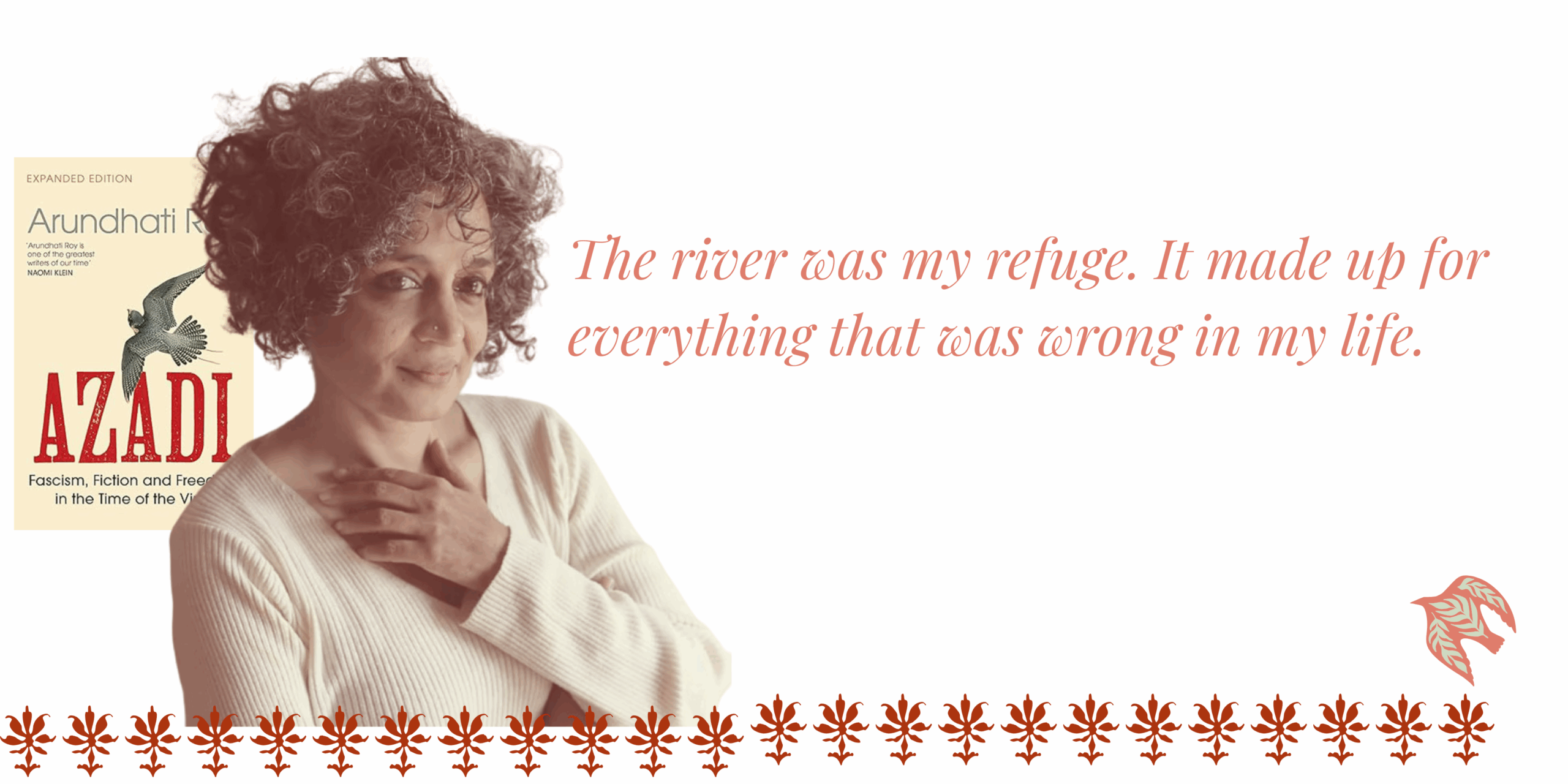
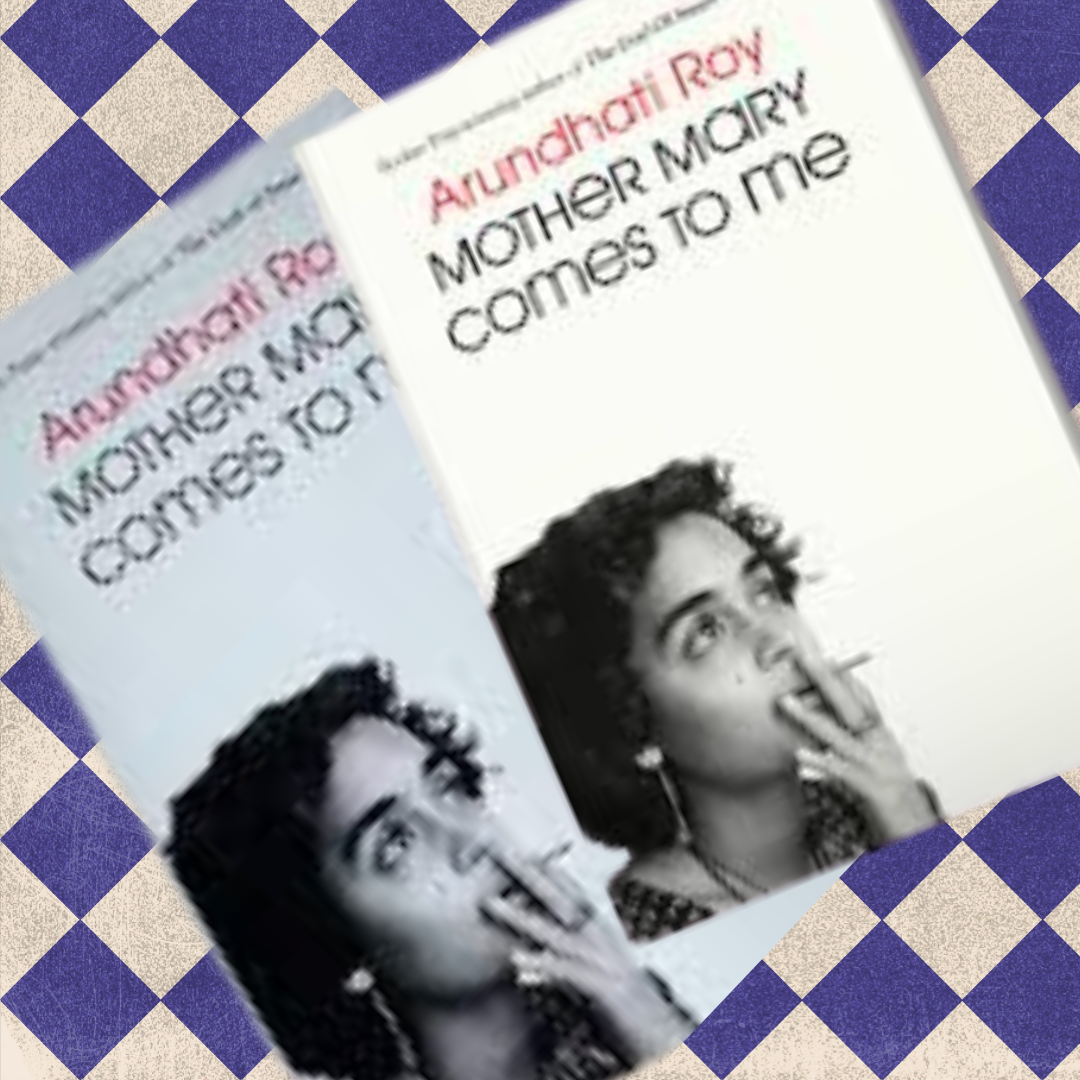



Booker Prize winning author Arundhati Roy releases her first memoir, Mother Mary Comes to Me.
It is an unflinching account of her volatile and complicated bond with her mother, Mary Roy. Arundhati Roy describes her mother as “my shelter and my storm.”
Roy first rose to fame with The God of Small Things, which won the Booker Prize in 1997. She later wrote The Ministry of Utmost Happiness and several acclaimed essay collections. Her voice has long unsettled power. She has spoken against dams, nuclear weapons, nationalism, and war. She remains one of India’s most fearless public intellectuals.
As Roy has said some writing has “the political necessity of honestly looking despair in the eye.”
The memoir appears at a moment when Roy’s writing faces fresh scrutiny. Her essay collection Azadi was recently banned in Jammu and Kashmir. Authorities in India-held Kashmir raided multiple bookshops claiming the bookis ‘Promoting Victimhood and Terrorist Heroism’. Twenty-five books by acclaimed scholars, writers, and journalists have been banned in Kashmir. The move has drawn widespread criticism, with students and researchers describing it as an attempt to impose collective amnesia
Human rights activist Roy has also denounced the war on the Palestinians “for the sake of the living and in the name of the dead.”
In her book she turns her laser-eyed clarity inward. She writes of grief, love and the mother-daughter bond that shaped her as both a woman and a writer.
Available in Pakistan at Liberty Books
Mother Mary Comes to Me: Arundhati Roy
This is a part of an excerpt from Mother Mary Comes to Me by Arundhati Roy, published by Penguin Random House India, first appeared in Vogue magazine. Penguin Random House India and the author retain all rights to the work.
The full excerpt can be read here.
A teacher was what my mother had always wanted to be, what she was qualified to be. During the years she was married to and living with our father, who had a job as an assistant manager on a remote tea estate in Assam, in northeastern India, the dream of pursuing a career of any kind atrophied and fell away. It was rekindled (as nightmare more than dream) when she realized that her husband, like many young men who worked on lonely tea estates, was hopelessly addicted to alcohol.
When war broke out between India and China in October 1962, women and children were evacuated from border districts. We moved to Calcutta. Once we got there, my mother decided that she would not return to Assam. From Calcutta we traveled across the country, all the way south to Ootacamund—Ooty—a small hill station in the state of Tamil Nadu. My brother, LKC—Lalith Kumar Christopher Roy—was four and a half years old, and I was a month away from my third birthday. We did not see or hear from our father again until we were in our 20s.
In Ooty we lived in one half of a “holiday” cottage that belonged to our maternal grandfather, who had retired as a senior government servant—an imperial entomologist—with the British government in Delhi. He and my grandmother were estranged. He had severed links with her and his children years ago. He died the year I was born.
I don’t know how we got into that cottage. Maybe the tenant who lived in the other half had a key. Maybe we broke in. My mother seemed familiar with the house. And the town. Perhaps she had been there as a child, with her parents. The cottage was dank and gloomy with cold, cracked cement floors and an asbestos ceiling. A plywood partition separated our half from rooms that were occupied by the tenant. She was an old English lady called Mrs. Patmore. She wore her hair in a high, puffy style, which made us wonder what was hidden inside it. Wasps, we thought, my brother and I. At night she had bad dreams and would scream and moan. I’m not sure if she paid any rent. She might not have known whom to pay it to. We, certainly, paid no rent. We were squatters, interlopers—not tenants. We lived like fugitives amid huge wood trunks packed full of the dead imperial entomologist’s opulent clothes—silk ties, dress shirts, three-piece suits. We found an old biscuit tin full of cuff links. (Obviously my grandfather was an enthusiastic collaborator with the colonial government and took the imperial part of his professional designation seriously.) Later, when my brother and I were old enough to understand, we would be told the legendary family stories about him: about his vanity (he had a portrait of himself taken in a Hollywood photo studio) and his violence (he whipped his children, turned them out of the house regularly, and split my grandmother’s scalp open with a brass vase). It was to get away from him, our mother told us, that she married the first man who proposed to her.
Quite soon after we arrived, she got a teaching job at a local school called Breeks. Ooty was, at the time, swarming with schools, some of them run by British missionaries who had chosen to stay on in India after independence. She became friends with a group of them who taught at an all-white school called Lushington, which catered to the children of British missionaries working in India. She managed to persuade them to let her sit in on their classes when she had time off from her job. She hungrily absorbed their innovative teaching methods for primary schoolchildren (flash cards for reading and phonetics, colored wood Cuisenaire rods for math) while being simultaneously disturbed by their kindly, well-meaning racism toward Indians and India. When she was away at work, she left us for a few hours with a sullen woman and occasionally with neighbors.
A few months into our fugitive life, my grandmother (the entomologist’s widow) and her oldest son—my mother’s older brother, G. Isaac—arrived from Kerala to evict us. I hadn’t seen either of them before. They told my mother that under the Travancore Christian Succession Act, daughters had no right to their father’s property and that we were to leave the house immediately. It didn’t seem to matter to them that we had nowhere to go. My grandmother didn’t say much, but she scared me. She had conical corneas and wore opaque sunglasses. I remember my mother, my brother, and me holding hands, running through the town in panic, trying to find a lawyer. In my memory it was night, and the streets were dark. But we did manage to find a lawyer, who told us that the Travancore Act applied only in the state of Kerala, not Tamil Nadu, and that even squatters had rights. He said that if anyone tried to evict us, we could call the police. We returned to the cottage shaking but triumphant. My brother and I were too young to understand what the adults were saying. But we understood the emotions at play: intimidation, fear, anger, panic, reassurance, relief, triumph.
Our uncle G. Isaac could not have known then that by trying to evict his younger sister, he was laying the ground for his own downfall. It would be years before my mother had the means and the standing to challenge the Travancore Christian Succession Act and demand an equal share of her father’s property in Kerala. Until then, she would shield and safeguard this memory of her mortification as though it were a precious family heirloom, which, in a way, it was.
After our legal coup we expanded into the cottage, made ourselves some space. My mother gave away the imperial entomologist’s suits and cuff links to taxi drivers at the taxi stand near the market, and for a while Ooty had the best-dressed taxi drivers in the world.
Despite our hard-won but still-tentative sense of security, things didn’t go our way. The cold, wet climate in Ooty aggravated my mother’s asthma. She would lie under a thick metallic-pink quilt on a high iron cot, breathing great, heaving breaths, bedridden for days on end. We thought she was going to die. She didn’t like us standing around staring at her and would order us out of her room. So my brother and I would go off to find something else to stare at. Mostly, we swung on the low, rickety gate at the corner of the triangular compound, watching newlywed couples on their honeymoon holding hands and walking past our home on their way to romance each other in Ooty’s famous botanical gardens. Sometimes they stopped and gave us sweets and peanuts. A man gave us a catapult. We spent days perfecting our aim. We made friends with strangers. Once one of them grabbed my hand and marched me back into the house. He told my mother sternly that her daughter had chicken pox. He made me show her the blister on my stomach, which I had been showing off to anybody who cared to examine it. My mother was furious. After he left, she smacked me hard and told me I was never to lift my dress and show my stomach to strangers. Especially men.
It could have been her illness, or the medication, but she became extremely bad-tempered and began to hit us often. When she did this, my brother would run away and only come home after dark. He was a quiet boy. He never cried. When he was upset, he would put his head down on the dining table and pretend to be asleep. When he was happy, which wasn’t often, he would dance around me boxing the air, saying he was Cassius Clay. I don’t know how he knew who Cassius Clay was. I didn’t. Maybe our father told him.